The Great Compute Deflation: Why Your API Bill is About to Crash
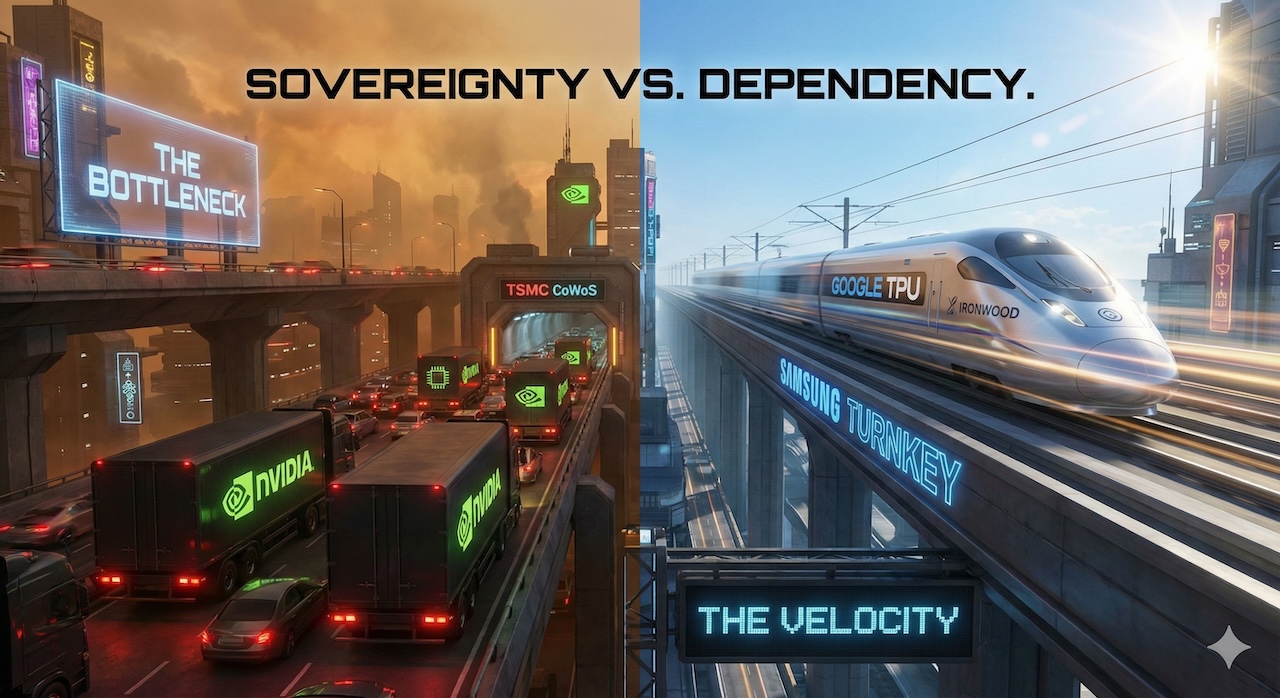
Amateurs talk strategy. Professionals talk logistics.
In the military, a tank is useless if you can’t get fuel to the front line. In the AI economy of 2025, an Nvidia H100 is useless if it’s stuck in a packaging facility in Taiwan.
For the last three years, we lived in a unipolar world. Nvidia was the sun. If you wanted intelligence, you paid the “Nvidia Tax”—a premium baked into their 80% gross margins.
That era ended this November.
While the market obsesses over benchmarks, Google and Samsung quietly dismantled the physics of Nvidia’s monopoly. The war is no longer about who has the fastest chip; it’s about who controls the flow of atoms and light.
Here’s why the “Intelligence Premium” is dead, and what it means for every builder paying an OpenAI or Anthropic bill.
The Primer (Know Your Weapons)
The AI industry uses jargon to hide simple economic realities. Here are the key terms:
1. Training vs. Inference (Medical School vs. Prescriptions)
Training is creating the model (feeding it data). It’s like sending a kid to medical school—costs buckets, takes years.
Inference is using the model (asking a chatbot). It’s the doctor writing a prescription—costs pennies, takes seconds.
The Shift: Nvidia owns “Medical School.” Google is aggressively driving the cost of “Prescriptions” to zero. As users, we pay for prescriptions.
2. GPU vs. TPU (Swiss Army Knife vs. Pneumatic Hammer)
GPU (Nvidia): A general-purpose chip. It can do anything (graphics, crypto, AI), but it’s expensive and power-hungry.
TPU (Google): A specialized chip designed only for AI math. It’s a pneumatic hammer—built to do one thing faster and cheaper than anything else.

3. CoWoS (The “Choke Point”)
Think of a chip like a sandwich. You have the silicon (bread) and the memory (meat). CoWoS is the machine TSMC uses to assemble the sandwich.
The Problem: TSMC has limited sandwich-making machines. This “packaging bottleneck” is why Nvidia chips are scarce.
TSMC is expanding aggressively—from 36,000 wafers per month in 2024 to 75,000-90,000 by end of 2025—but demand still outpaces supply.
4. Packet Switching vs. Optical Circuit Switching (Traffic Lights vs. Overpasses)
Nvidia (Packet Switching): Uses electronic routers. Data moves like cars in a city with traffic lights. More cars = congestion.
Google (Optical Circuit Switching): Uses mirrors to reflect light. It’s a highway overpass system. The cars (light) never stop. This lets Google build clusters 100x larger without gridlock.
The Supply Chain War
We are witnessing a shift from a Scarcity Economy to an Abundance Economy.
To understand why the “Nvidia Tax” is collapsing, you have to look at the architecture.
Nvidia dominates chip design, but they are a tenant in someone else’s factory. Every Blackwell chip and H100 must pass through TSMC’s CoWoS packaging lines.
Nvidia’s answer to scale is the NVL72 rack—72 Blackwell GPUs connected as a single domain. It’s impressive, but it’s still fundamentally a server rack.
Google’s answer is Ironwood.
Ironwood isn’t a rack; it’s a Pod containing 9,216 chips woven into a single 3D Torus mesh.
Nvidia:
- 72 chips talking to each other.

Google:
- 9,216 chips talking to each other.
- Google can chain these pods to reach 400,000+ chips in a single unified environment.
Why can Google scale so much larger? Because they stopped using traditional switches.
Nvidia clusters rely on Packet Switching (electronic routers). As you add more chips, traffic gets congested. It’s like adding more cars to a highway; eventually, you get gridlock.
Google uses Optical Circuit Switching (OCS). Instead of routing packets electronically, they use tiny mirrors (MEMS) to physically redirect beams of light through their Jupiter network architecture (Project Apollo).
- Latency: Near zero.
- Congestion: Non-existent.
- Flexibility: They can “rewire” the cluster in real-time to fit the model.
Nvidia is fighting physics with electronics. Google bypassed physics with optics.
Breaking Free from TSMC
With the launch of TPU v7 “Ironwood”, Google built an entirely parallel supply chain.
While Nvidia fights for access to limited CoWoS capacity at TSMC, Google is leveraging Samsung’s “Turnkey” solution. Samsung is the only player who can do it all under one roof: manufacture the chip, build the memory (HBM3E), and package it.
Current State
TPU v7 uses SK Hynix HBM3E memory. However, industry reports suggest Samsung is positioned as a potential future supplier as Google scales production, leveraging Samsung’s turnkey capabilities.
Why This Matters
Samsung Foundry historically struggled with lower yields compared to TSMC. At 3nm in early 2023, Samsung had yields around 10% while TSMC achieved 80%. But by late 2023, Samsung dramatically closed this gap—achieving 60% yield at 3nm versus TSMC’s 55%, and 75% yield at 4nm versus TSMC’s 80%.

While TSMC remains the industry leader in manufacturing consistency, Samsung’s improvement trajectory is undeniable.
By building a supply chain that bypasses the TSMC bottleneck, Google has decoupled from Nvidia’s pricing structure.
Reports suggest the Total Cost of Ownership (TCO) for a TPU cluster is approximately 40-50% lower than comparable Nvidia GB200 systems.
This is why Anthropic signed up for 1 million TPUs in October 2024—a deal worth tens of billions of dollars. Meta is in talks. These giants aren’t switching because they like Google; they’re switching because the unit economics are undeniable.
The Edge Economics Revolution
While Google attacks from the cloud, Samsung and Apple are aiming to attack from our pockets.
Samsung just unveiled a breakthrough that compresses a 30-billion-parameter model (normally requiring 16GB+ RAM) to run on under 3GB of memory. Dr. MyungJoo Ham from Samsung Research AI Center revealed this 5x memory reduction through advanced quantization techniques, bringing cloud-level AI performance to smartphones.
Apple isn’t sitting still. At WWDC 2025, they introduced the Foundation Models framework, giving developers direct access to Apple’s ~3-billion-parameter on-device model that powers Apple Intelligence features.
Available in iOS 26, iPadOS 26, and macOS 26, developers can integrate AI into their apps with as few as three lines of Swift code, with all processing happening on-device without user data leaving the phone.

Currently, these on-device models aren’t replacing frontier models as they’re optimized for specific tasks such as summarization, text extraction, and simple generation. However, expect improvements to compound quickly as both firms push edge computing to boost smartphone sales and reduce reliance on cloud APIs.
The trajectory is clear: Within 18-24 months, the majority of everyday AI interactions—email summaries, smart replies, basic content generation will run entirely on your smartphone. Not “Frontier class” in raw capability, but good enough that most users won’t need to ping a cloud API for routine tasks.
The Skeptic’s Reality (The Traps)
Before you celebrate the death of high prices, understand the new risks. There is no such thing as free money.
1. The “Google Trap” (Cloud Lock-in)
Nvidia’s “CUDA” language is the industry standard. If you build on it, you can move anywhere.
Google’s infrastructure is a walled garden. If you optimize for their cheap TPUs, you’re stuck in their cloud. If they raise prices next year, you have no exit.
2. The “Padding Tax”
TPUs hate messiness. They like orderly data. If your app sends variable-length text (like most chatbots), the TPU often has to “pad” it with empty data to process it.
You might pay for 128 tokens to process 10 words. For the wrong workload, “cheaper” becomes expensive.

3. The Yield Question
Google is betting heavily on Samsung Foundry. While Samsung has dramatically improved yields in recent years, TSMC still maintains superior manufacturing consistency at scale.
Either Google or Samsung may currently be absorbing efficiency losses to maintain competitive pricing. You are building on a supply chain that could see cost adjustments as market dynamics shift.
4. The Edge AI Trap
On-device AI sounds perfect: zero marginal cost, no API bills, complete privacy.
But here’s the catch:
Device Fragmentation: Your AI feature might work brilliantly on iPhone 16 Pro (8GB RAM), but will crashe on iPhone 15 (6GB RAM). You’re now maintaining multiple model versions for different hardware tiers.
Update Lag: Cloud models improve weekly. On-device models update when users install OS updates. Good luck getting enterprise users to upgrade from iOS 25 to iOS 26.
The Capability Ceiling: A 3B-parameter model running on a phone will never match a 405B-parameter model running on a server farm. For complex reasoning, multi-step planning, or domain expertise, you’ll still need the cloud.
Battery Physics: Running local AI drains batteries. Users notice. If your app kills their battery life, they delete it, regardless of how “private” it is.
The Hidden Cost: You’re not paying API fees, but you’re paying in:
- Engineering time to optimize for different devices
- User support for “why doesn’t this work on my phone?”
- Model degradation as you compress capabilities to fit memory constraints
The promise of “free on-device AI” is like the promise of “free solar power.” The panels (models) might be free, but installation, maintenance, and reliability still cost you.
What’s at Stake for You
Most of us aren’t buying H100s. We’re buying APIs. We’re building workflows. Here’s how “Compute Deflation” changes your business model.
1. The “Intelligence Moat” is Gone
For two years, “access to intelligence” was a differentiator. Now, with Google and Nvidia in a price war, intelligence will soon become a utility.
Don’t charge for the AI. If your business model is “I resell GPT-5.1 or Gemini 3 or Sonnet 4.5,” you’re dead.
Charge for the Workflow. The value isn’t the answer; it’s the integration, the data pipeline, the domain expertise.
2. Build a “Model Router” (The Arbitrage Play)
We are moving to a multi-polar world. Anthropic demonstrates this: they run workloads across Google’s TPUs, Amazon’s Trainium chips, and Nvidia’s GPUs.
Action: Do not hardcode any AI model into your workflows.
Build a Router: Develop a logic layer that routes traffic based on:
- Complexity: Simple queries → on-device or cheap cloud models
- Latency requirements: Real-time → edge/local models
- Cost: Batch jobs → whoever’s cheapest this month
- Reliability needs: Mission-critical → proven infrastructure
Loyalty to a specific model makes no sense. Be ruthlessly pragmatic about cost per token. Most frontier models provide similar end results barring a few edge cases for regular business workflows

3. Know Your Use Case
Not all AI workloads are created equal:
Edge-First Use Cases:
- Email/message autocomplete
- Photo organization
- Voice transcription
- Basic summarization
Cloud-First Use Cases:
- Complex research and analysis
- Multi-document reasoning
- Domain-specific expertise (legal, medical, financial)
- Anything requiring current information
Your Job: Map your features to the right tier. Use edge for the 80% of simple tasks. Reserve cloud APIs for the 20% that actually need intelligence.
The Bottom Line
The “Nvidia Tax” was the cost of early adoption. In 2026, raw intelligence is becoming a commodity, both in the cloud and increasingly on-device.
Those who will survive the next 18 months will be those who understood that intelligence is infrastructure, and infrastructure always gets commoditized.
The question isn’t “Which model should I use?”
The question is “What problem am I solving that can’t be solved with cheap or free intelligence?”
If you don’t have a good answer, you’re building on quicksand.
Further Reading
Core Technical Sources:
Supply Chain & Economics:
Optical Circuit Switching:
Edge AI:
- Samsung 30B Parameter Compression
- Apple Foundation Models Framework
- Apple Foundation Models Research
Market Analysis: