The Relationship Tax: Why "Being Right" is Bad for Business

- Is it ethical to pay an informal “tax” to make operational headaches disappear? - No.
- Is it moral? - Probably not.
- Is it profitable? - That is the only question that matters to your P&L.
Growing up, we are often told to stand our ground. We are told that integrity means fighting every injustice and pushing back against every unreasonable demand. We call this “strength.”
But in 2022, I learned a hard lesson: sometimes, what looks like strength is actually just ego. And sometimes, the strongest move you can make is to walk away or work within the system
The War of Attrition
In early 2023, We won new a security contract at a large manufacturing plant. It was a “Golden Goose” account: ₹3 Lakhs in monthly revenue, healthy margins, and crucially, the customer paid early.
This meant zero working capital deployment from our side, a rare gem in the security services business.
But the on-site Admin Lead had issues
For 47 consecutive days, my team woke up to a barrage of complaint emails.
- “Guards are arriving late.”
- “Guards presentation is not up to standard.”
- “Logbook entry has errors.”
These were minor, and mostly manufactured issues. But the Admin Lead was weaponizing them. He was creating a paper trail of “service failures,” copying senior management on every minor infraction.
My field staff were demoralized. My operations manager was furious. “We’re doing everything right,” he said. “Why can’t they see that?”
The Trap of Blind Strength
My initial reaction was visceral. I wanted to fight.
I wanted to adopt a posture of Blind Strength. I wanted to document every single rebuttal, escalate the issue to his boss at HQ, and prove, mathematically and logically, that we were right and he was wrong.
It would have felt incredibly satisfying. But it would have been a disaster.
The Admin Lead had been there for over 10 years. He had deep reliability and credibility within the organization. If I fought him, it would be my word against a decade of tenure. Even if I “won” the battle and proved him wrong this month, the system would strike back next month.
I realized I didn’t need to win the argument. I needed to save the ₹36 Lakh annual revenue stream.
Finding the Ghost in the Machine
I told my team to stand down. Instead of fighting, we investigated.
My Ops Manager spent a few days digging into the site dynamics and discovered the real issue. The on-site Security Officer, an informal gatekeeper, was paid a ₹8,000 monthly “cut” by the previous vendor. We suspected this wasn’t just for him; it was likely distributed across a small ecosystem of on-site staff.
We weren’t paying it. So, we were facing an onslaught of complaints.
This wasn’t a performance issue at all.
I sat down and looked at the numbers. This was the moment of truth. I had to separate my ego (“I won’t be bullied”) from my business logic (“Does this contract make money?”).
The math was clear: Even with an additional ₹8,000 monthly expense, which my team calls as “Relationship Tax”, the contract still had a stellar ROI.
Strategic Weakness
We didn’t fight. We didn’t escalate. Instead, my ops manager had a quiet conversation with him over drinks. He told him, “We understand we are new, and we want to make sure things remain the same as they were before.”
We paid the toll. Indirectly. Carefully.
The complaints stopped overnight. Not gradually—immediately. The “service failures” vanished. The emails stopped.
I didn’t create the corrupt system; the client’s culture did. Rather than wasting my time and energy to push for a change in their culture, I chose to navigate it.
The Cost of Doing Business
This is the part of business that most of us don’t like to talk about.
Ethically, paying that ₹8,000 was uncalled for. I could have aimed to be perfectly ethical. I could have refused to engage with such nonsense.
But the result would have been the loss of a ₹3 Lakh/month contract
This is the Cost of Doing Business. It exists across the ecosystem, often hidden in “consultancy fees,” “liaison charges,” or “informal tolls.” My team calls this the Relationship Tax.
You can choose to be a martyr. You can choose to fight a system where the opponent has 10 years of tenure and you have 47 days of “complaints.” You might even feel good about your moral stance initially, but not when you lose the easy revenue for your business.
Or, you can accept that your job isn’t to fix the world’s morals; it’s to ensure that you work within the constraints of a system to grow your business (and maybe walk away from such deals later on).
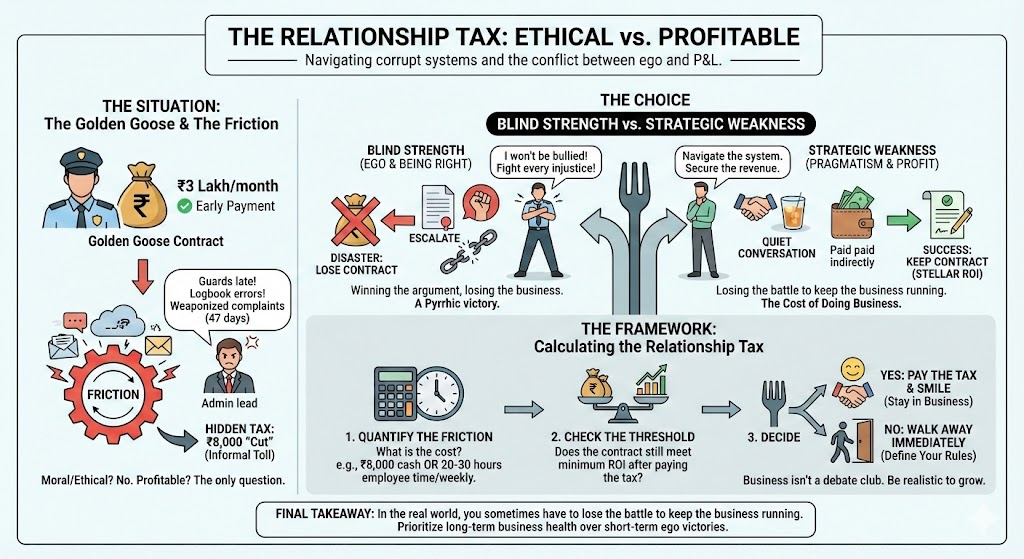
The Framework: Calculating the Tax
When you encounter friction that feels unfair, don’t let your ego drive. Just do the Relationship Tax Calculation:
-
Quantify the Friction: What is the cost of this problem? (e.g., ₹8,000 cash OR 20-30 hours of your employee’s time weekly).
-
Check the Threshold: If you pay this tax, does the contract still meet your minimum ROI calculations?
-
Decide: If YES: Pay the tax, smile, and get back to work. If NO: Walk away immediately.
Business isn’t a debate club. You don’t get points for being right. You get to stay in business by being realistic.
If the ROI clears the hurdle but you still can’t stomach the tax, walk away. That is your decision to make. You define your rules of engagement.
Just remember: in the real world, you sometimes have to lose the battle to keep the business running
- I discuss more key lessons I learned over the years in my post: Payroll, Power, and Reality: 5 Business Lessons I Learned the Hard Way
- Understanding mental models to improve your thinking