Compute Wars: Why I Stopped Renting the Hype
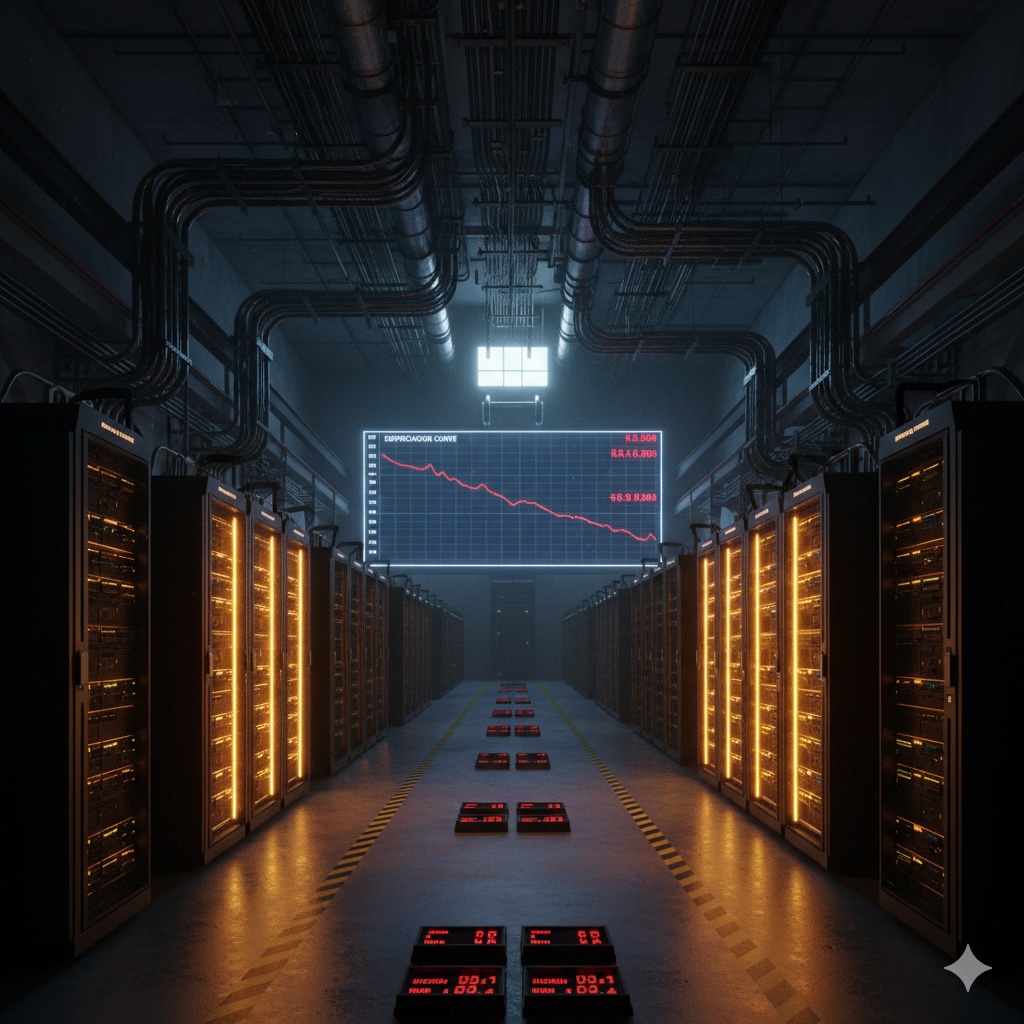
In thermodynamics, heat is the ultimate waste. In business, the equivalent is depreciation.
While building O9X, I realized I was pouring money into boxes that age like fruit on a warm day. My AI bill didn’t just represent “compute”; it represented a race where the floor moves faster than the runners.
The AI buildout isn’t optional for big tech. But for an operator like me, it’s a trap. We are replacing durable industrial infrastructure with fast-decaying silicon.
The Nvidia Chokepoint
Nvidia isn’t just a supplier; it’s the gravitational center of the AI universe. If an AI model provider decides to switch to a different chip other than Nvidia, the technical debt of rewriting their CUDA-optimized stack almost kills thire project.
The lock-in isn’t technical; it’s organizational. Nvidia knows this. Their pricing power is absolute because moving away isn’t a technical choice—it’s a brain transplant.
What I learned: Never treat Nvidia as “just another vendor.” They are a single point of failure. Your risk isn’t about chips going out of stock; it’s about being tethered to a single company’s roadmap.
The GPU Banana Problem
Hardware cycles are brutal. That H100 cluster you proudly deploy today will be obsolete by year three.
Unlike fiber-optic cables that stay in the ground for 20 years, GPUs are bananas. They rot. Every purchase commits you to a treadmill of reinvestment. If you stop, you’re stuck with an uncompetitive fleet while someone else leaps ahead.
- The Math: If your ROI period is >36 months, you’ve already lost.
- The Reality: You aren’t building “infrastructure.” You’re renting a temporary advantage.
The Inference Tax (OpEx is the Boss)
People love talking about the $100M training runs because they sound impressive. But for O9X, training was just the opening act. The real killer is inference.
Every query triggers a cost. Unlike traditional software where the marginal cost is zero, AI has a stubborn floor. You pay for every token.
- My Rule: Treat inference as COGS, not “infrastructure.”
- Specifics: If your cost-per-query eats 10% of your margin today, it’ll eat 50% tomorrow when users start scaling their usage.
Power: The Hard Constraint
Silicon used to be the bottleneck. Now it’s gigawatts. You can see data center roadmaps collapse not because they lacked chips, but because they couldn’t plug them in.
Grids don’t scale at the speed of venture capital.
Sovereign AI projects are popping up globally, but without local energy independence, they are just expensive paperweights.
The Operator’s Playbook
In a world where compute costs balloon and hardware ages fast, the only strategy is discipline.
- Calculate ROI on a 3-year floor. If it doesn’t pay back by month 30, don’t buy it.
- Ruthless Cost Visibility. If you don’t know your cost-per-query to three decimal places, you aren’t running a business; you’re running a charity for cloud providers.
- Plan for Power early. Electricity is the new gating factor.
What I learned from documenting this: Writing this forced me to admit that my fascination with “frontier models” was a distraction. I’ve since moved lot of my routine tasks to smaller, local models. My latency dropped by 200ms and my monthly bill fell by ₹8,500. Documentation cured my hype-blindness.
Your takeaway: Map your compute dependencies today. If one vendor owns your stack and one grid owns your power, you don’t have a business—you have a lease that can be revoked at any time.