The GPU Banana – Why My AI Bill Tripled (And Why It Might Not Matter)
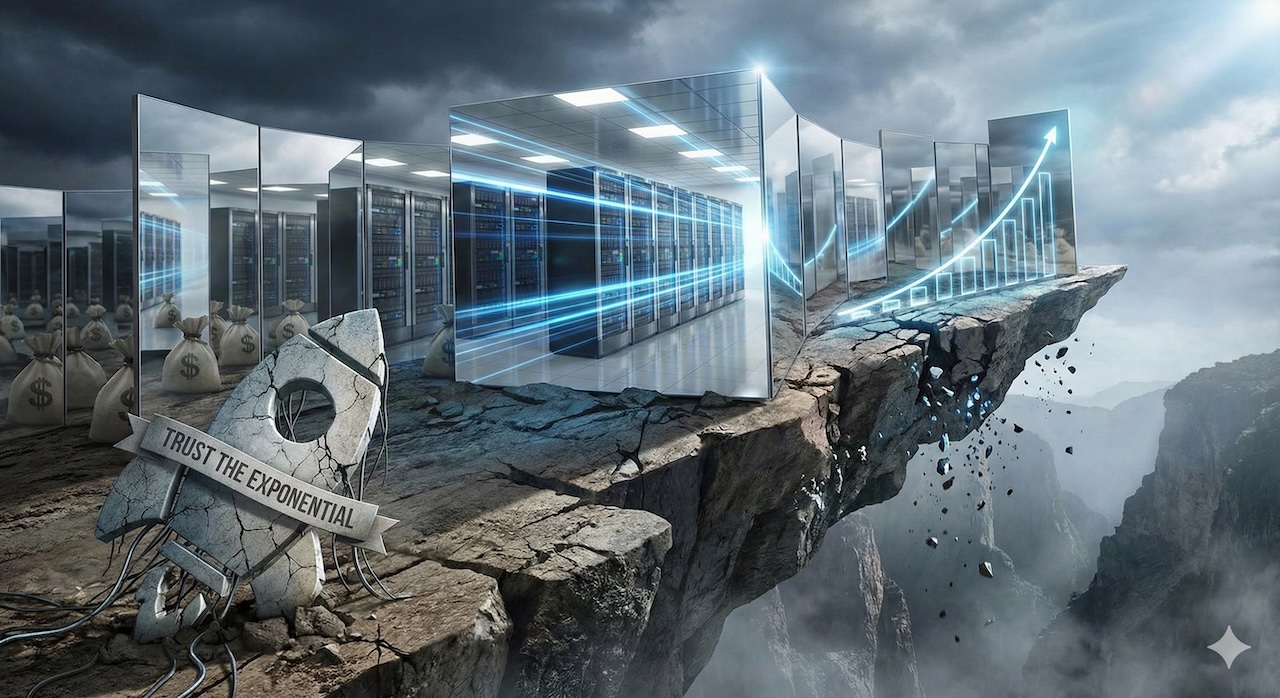
In physics, entropy always wins. In business, the equivalent is depreciation.
Last month, my AI bill tripled in 30 days—jumping from ₹15k to ₹45k. Not because our traffic exploded, but because I was building O9X and chasing the “next big model” without checking the ROI floor. I was playing the same high-stakes game as the tech giants, just on a smaller scale.
The AI economy right now isn’t a rocket ship. It’s a hall of mirrors built on circular funding and hardware that rots like fruit.
The Rotting Banana Problem
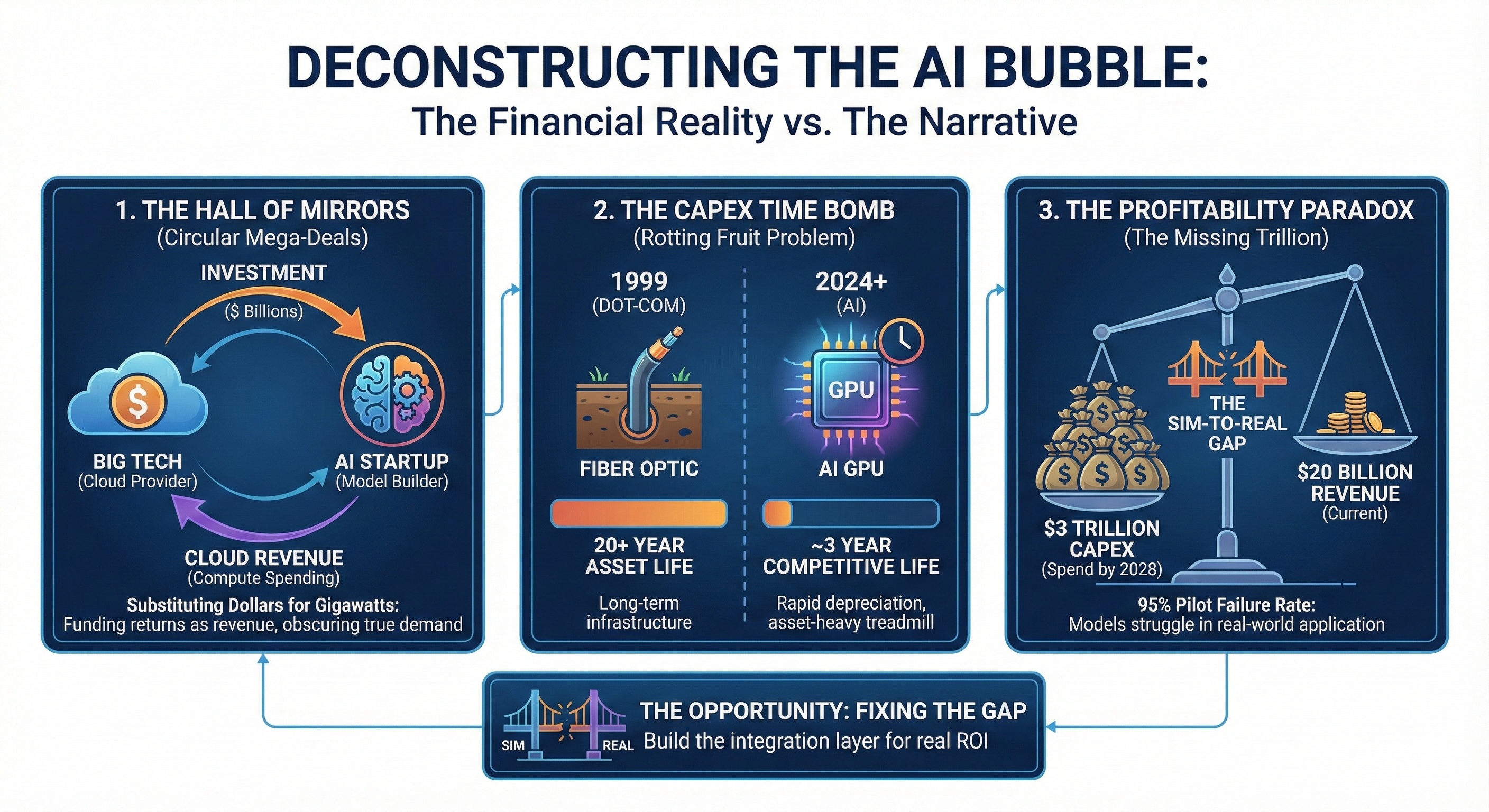
Skeptics compare this to the Dot-Com bubble. They’re wrong. In 1999, we laid fiber-optic cables. If the company died, the glass stayed in the ground for 20 years. It was a long-term asset.
The AI GPU is not a bridge; it belongs in the produce section. It has a competitive shelf life of roughly 3 years before it’s obsolete.
- The Treadmill: Hyper-scalers must spend $3 Trillion by 2028 just to stay current.
- The Shift: Profit machines like Meta and Microsoft are becoming asset-heavy utilities. Their Capex-to-Revenue ratios (28-35%) now rival energy companies.
If the revenue doesn’t show up before the chip rots, the investment goes to zero.
The Trillion-Dollar Chasm
To justify this $3 Trillion bill, the industry needs to produce over $1 Trillion in annual revenue. Right now, actual GenAI revenue is hovering around $20 Billion.
That is a 50x gap.
The Sim-to-Real Gap
Why isn’t the money showing up? Because of what I call the Sim-to-Real Gap.
Models crush benchmarks (Sim), but they collapse when they hit messy corporate data (Real). MIT found that 95% of enterprise AI pilots fail.
In my security business, I tried using AI to automate night-shift incident reporting. On paper, it saved 3 hours of founder attention. In reality, the “hallucination cleanup” took 4 hours. The efficiency was a mirage.
The Circular Hall of Mirrors
When you see a startup raise $10 Billion from Microsoft, look at the fine print. Often, that money is “compute credits.”
- The Loop: Microsoft invests in OpenAI → OpenAI pays Microsoft for Cloud → Microsoft books Cloud Revenue → Wall Street pumps Microsoft stock.
It’s reflexive. It creates an artificial sense of momentum. As an operator, this is dangerous because it masks true organic demand. We are substituting dollars for gigawatts.
My Strategy: Bridge the Boring Gap
I’m not building a foundational model. I’m not competing for GPUs. Instead, I’m looking at that 95% failure rate as my primary market.
The giants are stuck in the “Circle.” The opportunity is in the middle: the unglamorous integration layer that actually makes this tech work for a ₹1.3 Cr revenue business without destroying the ₹6L profit margin.
What I’m still figuring out:
- Is the “Thinking Firewall” approach enough to close the Sim-to-Real gap, or are we just adding more layers of compute to a broken engine?
- How to keep my AI costs under 5% of gross margin while everyone else is racing to zero.
Key takeaway: Don’t buy the “exponential” narrative. Buy the raw materials—energy, integration, and boring reliability.
Your takeaway: Use the AI ROI Calculator to see if your experiment has a floor or if you’re just buying rotting fruit.
What I learned from documenting this: Writing this forced me to admit that my ₹45k bill was a vanity expense. I’ve since cut out three “experimental” workflows that had zero impact on my net profit. Documentation is the ultimate firewall against self-deception.