Tier 1 Problems: Why Most Product Launches Fail

Most failed product launches don’t fail because the technology is bad. They fail because they solve a “Tier 3” problem—something that sounds important in a boardroom but never shows up on a balance sheet.
I learned this lesson the expensive way with video analytics. I spent months perfecting automated threat detection and “revolutionary” monitoring capabilities. When I finally pitched it, the feedback was unanimous: “The tech is great, but we can’t even get the budget to buy the cameras.”
I was selling a Ferrari to people who couldn’t afford a paved road. Success isn’t about the solution; it’s about finding the Tier 1 pain.
The Problem Hierarchy
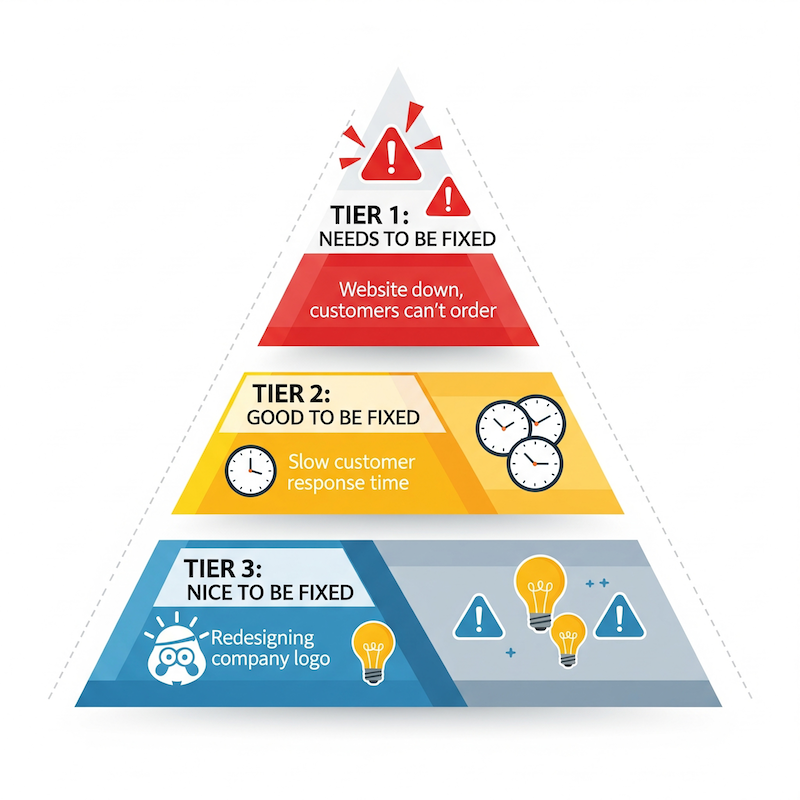
If you want to survive as a entrepreneur, you must ruthlessly categorize every problem you find:
- Tier 1: Must-Fix. These cause immediate bleeding. Lost revenue, critical system failures, or legal compliance risks. Customers have a budget already allocated for these because they have no choice.
- Tier 2: Should-Fix. Inefficiencies or minor frustrations. Customers will talk about these for hours but won’t sign a check to fix them until “next quarter.”
- Tier 3: Could-Fix. Academic optimizations. These are the “nice-to-haves” that win awards but lose businesses.
My video analytics solution was a Tier 3 distraction. The client’s Tier 1 problem was basic theft control and unauthorized access. They didn’t need AI; they needed a way to buy cameras without an upfront capital hit.
The Workaround Test
How do you know if a problem is Tier 1? Look for the “ugly workaround.”
If a customer is manually monitoring 10 feeds with two guards and a spreadsheet, they have a Tier 1 problem. They are already spending time and money to fix it poorly. If they aren’t trying to fix it with a clumsy manual process, it isn’t a real problem.
The Rule: If there is no workaround, there is no pain. If there is no pain, there is no sale.
The 80/20 Integration Rule
The biggest barrier to adoption isn’t your price; it’s the operational friction. My initial proposal failed because it required the security team to learn new software, rewrite protocols, and change their entire workflow.
Successful products follow the 80/20 rule: 80% of the workflow stays exactly the same; 20% is where your unique value lives. If your “solution” requires a client to change their culture, you’ve already lost. Risk-averse customers want enhancement, not disruption.
The “Price Talk” Filter
Stop looking for “interest.” Start looking for budget.
During my analytics pilot, dozens of customers “loved the concept.” They requested proposals and praised the UI. But only two asked: “How does this fit into my annual procurement budget?”
Those were the only two who bought.
For most small businesses, polite interest is a death sentence. It wastes your time. If the conversation doesn’t move to pricing structures and payment terms by the second meeting, you aren’t solving a Tier 1 problem.
How to Validate (The Brutal Way)
Forget surveys. Forget “would you buy this” questions.
- Interview 15 customers. Ask only about their workarounds. If they aren’t doing something manual to solve the problem, walk away.
- Force a Ranking. Ask them to rank their top 3 headaches. If your idea isn’t in the top 2, it’s a Tier 2 problem. You can’t build a bootstrap business on Tier 2.
- Pitch the Price early. If they flinch at the cost but don’t try to find a way to make it work, the pain isn’t high enough.
The Bottom Line
You can build a “good” product in a lab, but you find a “successful” one in the messy, manual workarounds of a frustrated customer. Look for the bleeding, not the optimization.